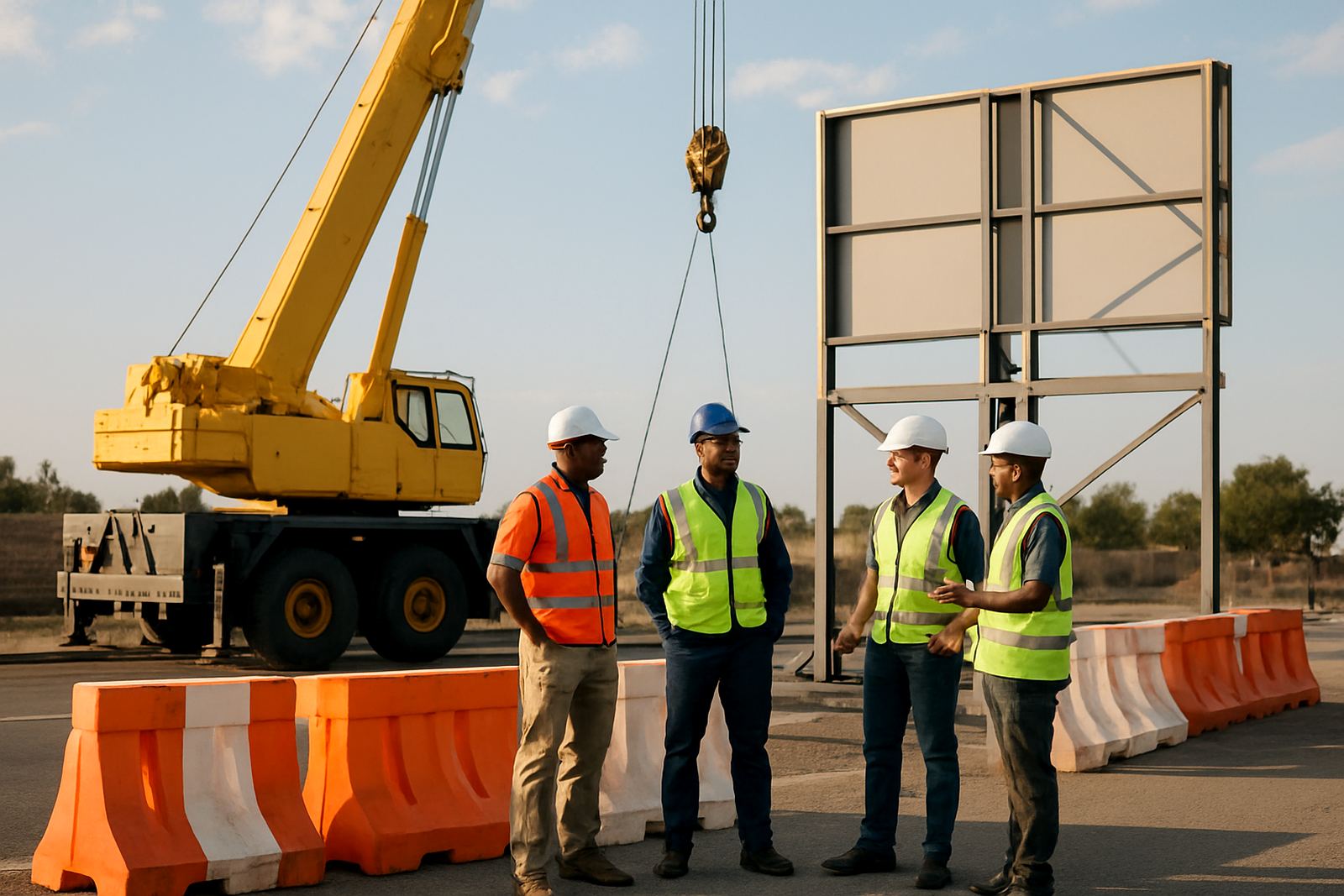
Why rigging plans matter on live sites
Sign installations are often carried out while the site is still trading, building or operating under municipal conditions. That means there are people walking, cars queuing, deliveries arriving and, in many cases, overhead services or traffic lanes that cannot simply be closed for the day. A rigging safety plan sets out how the work will happen without putting the public or the crew in harm’s way.
For a pylon on a retail edge, a road sign over a slip lane, or a video screen facing a forecourt, the plan should define the lift method, the set-down area, the exclusion zone and the sequence of work. It also needs to account for wind, night work, load-shedding, and the fact that some sites in Johannesburg or Pretoria sit very close to active roads where one mistake can stop traffic and cause delay.
What a practical safety plan should cover
A good plan is not just a drawing. It is a working document that guides the site team, the crane operator, the traffic controller and the client representative from arrival to handover. On our side, we align the safety plan with the structural information, access route and fabrication details so the rigging crew knows exactly what is being lifted and where the fixings land.
- Site access and delivery route for trucks, cranes or lift equipment
- Exclusion zones for the public, tenants and passing traffic
- Lift sequence, sling points and temporary support requirements
- Wind limits and weather checks for tall or lightweight panels
- Power isolation steps for illuminated signs and LED screens
- Communication method between the rigging crew and site management
- Emergency response steps if access is blocked or conditions change
When these items are written down before the crew arrives, there is less confusion and fewer surprises on the day.
Working above roads, forecourts and loading bays
The most sensitive jobs are those directly above traffic or in places where the public cannot be kept away easily. At a forecourt in Sandton, for example, the installation window may be short because the station must keep trading and tanker deliveries still have to move through. In that setting, the exclusion area must be tight, clearly marked and supervised, not just assumed.
For road-facing signage, we also look at the timing of the work in relation to peak traffic, municipal permissions and nearby intersections. In some cases, installation after hours is safer and quicker, but it still needs lighting, access control and a proper handover to the site team. A sign can look simple from the road, yet the rigging behind it may involve temporary barricades, spotters and controlled lifting from more than one point.
- Never rely on cones alone where vehicles or pedestrians move close to the lift
- Confirm that the ground can carry the crane outrigger loads or access equipment
- Check for overhead lines, trees, lighting poles and façade projections
- Keep a clear path for ambulance or fire access if the site is occupied
How Gauteng sites change the risk picture
Projects in Modderfontein, Midrand, Germiston and Centurion often sit within busy logistics, retail or commercial corridors. That means access can be tight, pavements are uneven and there may be pressure to complete the installation quickly before trading hours start. Coastal humidity is not the issue here, but wind exposure, dust and sudden weather changes can still affect lifting conditions.
For municipalities and developers, the rigging plan must fit the site rules, not fight them. Security protocols, working-hour restrictions and parking controls can all affect how the crew gets in and out. If a site is shared by tenants, the plan should also state how each tenant is protected during the lift and who signs off on the area being cleared. Small delays on paper are far better than a damaged façade or an unsafe lift.
LED screens and other high-risk installs need extra detail
LED video screens, large light boxes and fabricated 3D lettering bring their own risks because they are often heavy, awkward to handle and sensitive to power connections. A screen needs more than physical support. It needs a safe path for cabling, a confirmed power point, proper isolation during installation and a plan for future maintenance access.
Where a screen is installed on a pylon or building edge, the rigging team must know how it will be secured during the lift, how the brackets are checked and how the final alignment will be set. If the installation is happening in a live retail environment, the site manager should also know when the panel will be moved overhead so the area can be cleared in time.
- Confirm weight, dimensions and centre of gravity before rigging starts
- Use the correct fixings for steel, concrete or aluminium support structures
- Plan maintenance access from the beginning, not after the sign is already up
- Allow for load-shedding so lighting and screen testing can be completed safely
A local example from a retail forecourt in Johannesburg
A typical example is a forecourt branding upgrade on the edge of a busy Johannesburg arterial route. The client wants a new illuminated fascia, a directional pylon and a video screen visible from the road. Vehicles are still fuelling, deliveries continue and the forecourt cannot shut down for the week.
In a case like this, the rigging safety plan would split the work into stages. First comes access control and marking of the exclusion zone. Next comes the lift of the larger structural components during a low-traffic window. Then the electrical and final alignment work follows once the area is checked again. If wind picks up or traffic pressure increases, the sequence can be paused without losing control of the site. That kind of planning saves time, protects the public and keeps the client informed.
From safety plan to handover, keep the chain clear
Good rigging safety is not only about the lift. It starts at site survey stage, continues through structural coordination and ends at handover with the correct documentation in place. The same team that planned the installation should understand the access constraints, the approvals and the maintenance requirements, because the final outcome depends on all of those parts working together.
At Deep3 Signage Consultants, we support signage and LED screen projects with site surveys, approval support, fabrication management and installation management. That means the rigging plan is built around the actual job, not a generic checklist. When the site is in Sandton, Randburg, Pretoria or Durban, the principles stay the same: clear control, proper sequencing and no guesswork where people, traffic and overhead lifting are involved.