
Brief for a busy Kempton Park forecourt
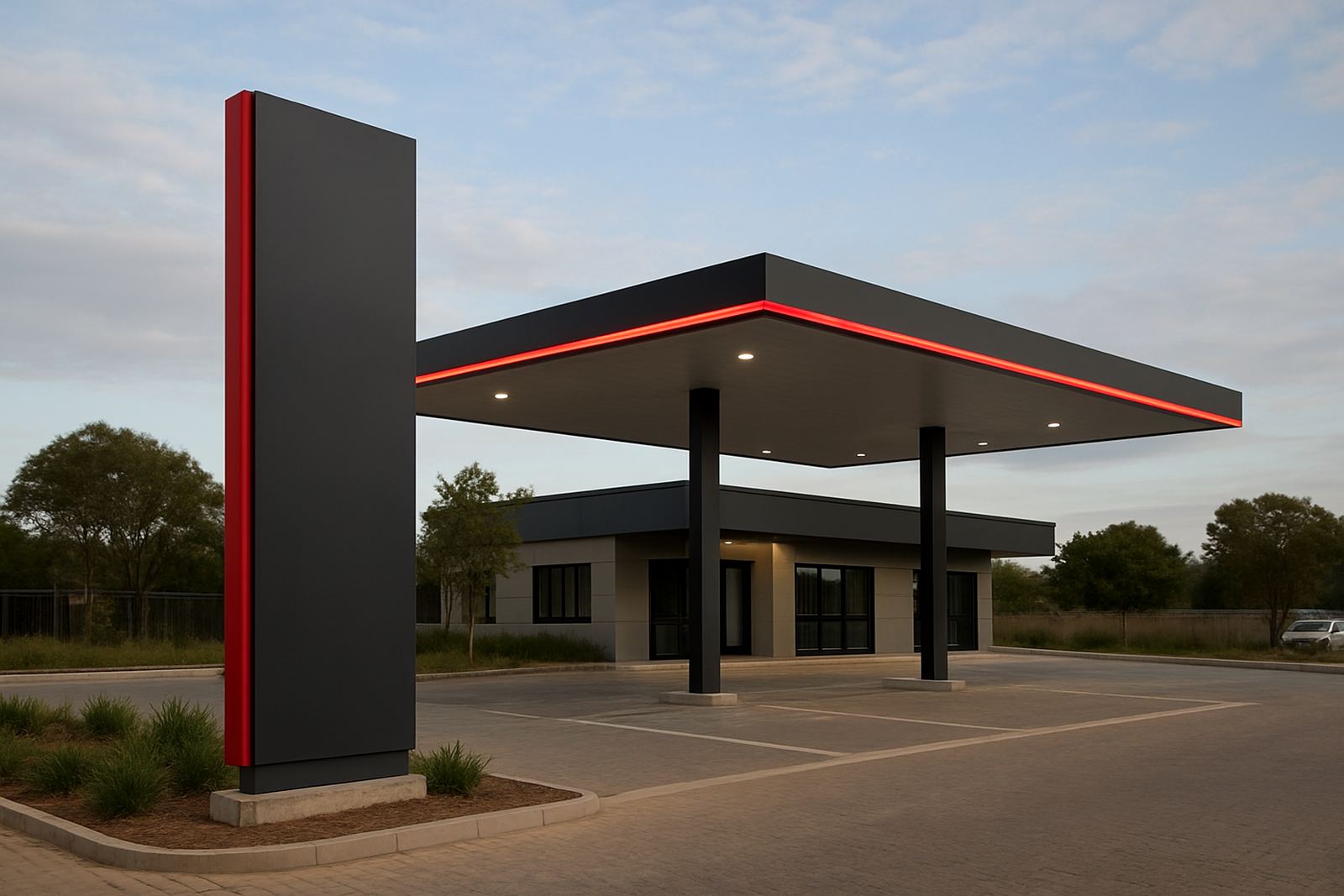
The client was a forecourt operator in Kempton Park working through a full redevelopment on a highly visible roadside corner. The brief was simple to say and tricky to deliver: create a prominent pylon sign that could carry the site identity clearly from traffic speed, then tie it back to canopy branding so the whole forecourt read as one property.
Because the site sits in a busy urban corridor with constant traffic, the sign had to work from a moving vehicle, not just at pedestrian level. The team also wanted something that would stand up to Gauteng sun, wind and dust, with materials that would not need constant attention once the forecourt opened.
- Roadside pylon for long-range visibility
- Canopy signage sized to suit the forecourt roofline
- Day and night legibility without overloading the structure
- Finish choices that would hold up in dust and summer heat
Site constraints, approvals and structural coordination
The site brought the usual redevelopment pressures: active traffic movements, limited laydown space, and a tight programme around other contractors finishing civil works. There was also the matter of local signage approvals and structural coordination, which had to be handled carefully before anyone could start drilling or lifting on site.
We carried out site checks to confirm sightlines, footing positions and the practical height needed to clear surrounding visual clutter. For the pylon, the aim was to get enough elevation for motorists approaching from both directions, while keeping within the property boundary and the allowed footprint. Structural coordination was done around wind loading, foundation details and access for maintenance, because a tall sign that is hard to service becomes a problem later.
- Visibility studies from the main approach roads
- Foundation and footing coordination for the pylon base
- Allowance for cable runs and future access panels
- Sign-off support for municipal and landlord review
We kept communication tight with the project team because the forecourt could not afford delays from one trade holding up another. That meant clear drawings, direct answers to queries and practical decisions on materials and fixings, not decorative ideas that would cost time later.
What we supplied and fabricated
The package included the tall roadside pylon, illuminated header elements and matching canopy fascia signage. We fabricated the main structure in steel with protective coatings, then clad the visible faces with aluminium and acrylic elements suited to illumination. The branding was built for clean daytime reading and even light output after dark, which matters on a forecourt that stays active into the evening.
For the canopy, we supplied signage that sat neatly with the roofline and did not interfere with the pumps, lighting or vehicle clearance. The graphics and letterforms were prepared for high contrast viewing, so the site would still be clear during load-shedding conditions or when the forecourt lighting was reduced. We also planned the maintenance points so replacement of lamps, drivers or face panels would not require major dismantling.
- Steel pylon frame with corrosion protection
- Aluminium face panels for durability
- Acrylic illuminated sections for day and night use
- Canopy fascia branding sized to the building line
- Service access planned into the fabrication from the start
Timeline from drawing board to rigging
The project ran over 8 weeks from initial site review to final handover. The first phase covered survey work, design development and material specification. The second phase covered fabrication management, where the structure, faces and lighting components were built and checked before dispatch. The final phase was installation management and rigging, timed to fit the redevelopment programme and site access windows.
On a site like this, the best outcome comes from a controlled sequence. The foundations had to be ready, the sign components had to arrive in the right order, and the rigging crew had to work around other contractors without creating rework. That is often the difference between a project that looks tidy on paper and one that opens on time in real life.
- Week 1 to 2: site survey and sign strategy
- Week 3: design development and approval support
- Week 4 to 6: fabrication and pre-assembly
- Week 7: delivery, rigging and electrical interface
- Week 8: final checks and handover
Results on the road and under the canopy
The finished package gave the forecourt a strong roadside presence and a clear identity at pump level. Drivers approaching the site can now pick it out earlier, and the canopy branding supports that first impression once vehicles enter the forecourt. The result is not just a bigger sign, it is a clearer site that does its job in daylight, at dusk and after dark.
From an operations point of view, the client gained a signage system that is easier to maintain and simpler to explain to future contractors. The materials were selected for local weather conditions, including strong sun, dust and periodic storms. On the electrical side, the lighting layout was planned to be practical during outages and maintenance periods, which is important for any fuel retail site in Gauteng.
It also helped that the visual package was not overcomplicated. The forecourt needed confidence, not clutter, and the completed pylon and canopy signs deliver that in a direct way.
What we would repeat on the next forecourt project
If we were doing this kind of site again, we would follow the same process: start with the road approach, confirm the viewing distance, then build the structure around real maintenance needs rather than just the first day appearance. That approach keeps the sign useful long after the opening ceremony.
For forecourts around Kempton Park, Germiston, Midrand or Centurion, the same lessons hold true. Confirm the approvals early, allow enough time for structural coordination, and specify materials that can handle Gauteng sun and dust without constant repair. If the site is near busy arterial traffic, sightlines should be tested before fabrication begins so the final sign works from the road, not only in the workshop drawings.
- Start with traffic approach, not just branding artwork
- Plan access panels and lighting service points early
- Choose coatings and fixings for local weather exposure
- Keep the sign package aligned to the opening programme
Key facts
| Project | Kempton Forecourt Pylon |
|---|---|
| Location | Kempton Park, Gauteng |
| Scope | Roadside pylon and canopy signage package |
| Timeline | 8 weeks |
| Primary materials | Steel, aluminium, acrylic |
| Services | Site Surveys, Design Development, Material Specification, Structural Coordination, Approval Support, Fabrication Management, Installation Management, Handover |