
Why shared pylons need a long view
A multi-tenant pylon is often the first sign people see when they enter a retail park, office estate or mixed-use precinct. It has to do more than show names. It must hold up to tenant churn, changing occupiers, municipal checks and the practical realities of maintenance on a busy site.
The mistake many owners make is to treat a pylon as a one-time build. In practice, tenant stacking changes, brand colours shift and new occupants arrive with different logo shapes and line lengths. If the structure was not planned for that from the start, a simple sign swap can mean extra steel, extra wiring and extra downtime. That is expensive, especially where a site cannot afford to lose visibility for a weekend.
Get the tenant stack right before fabrication starts
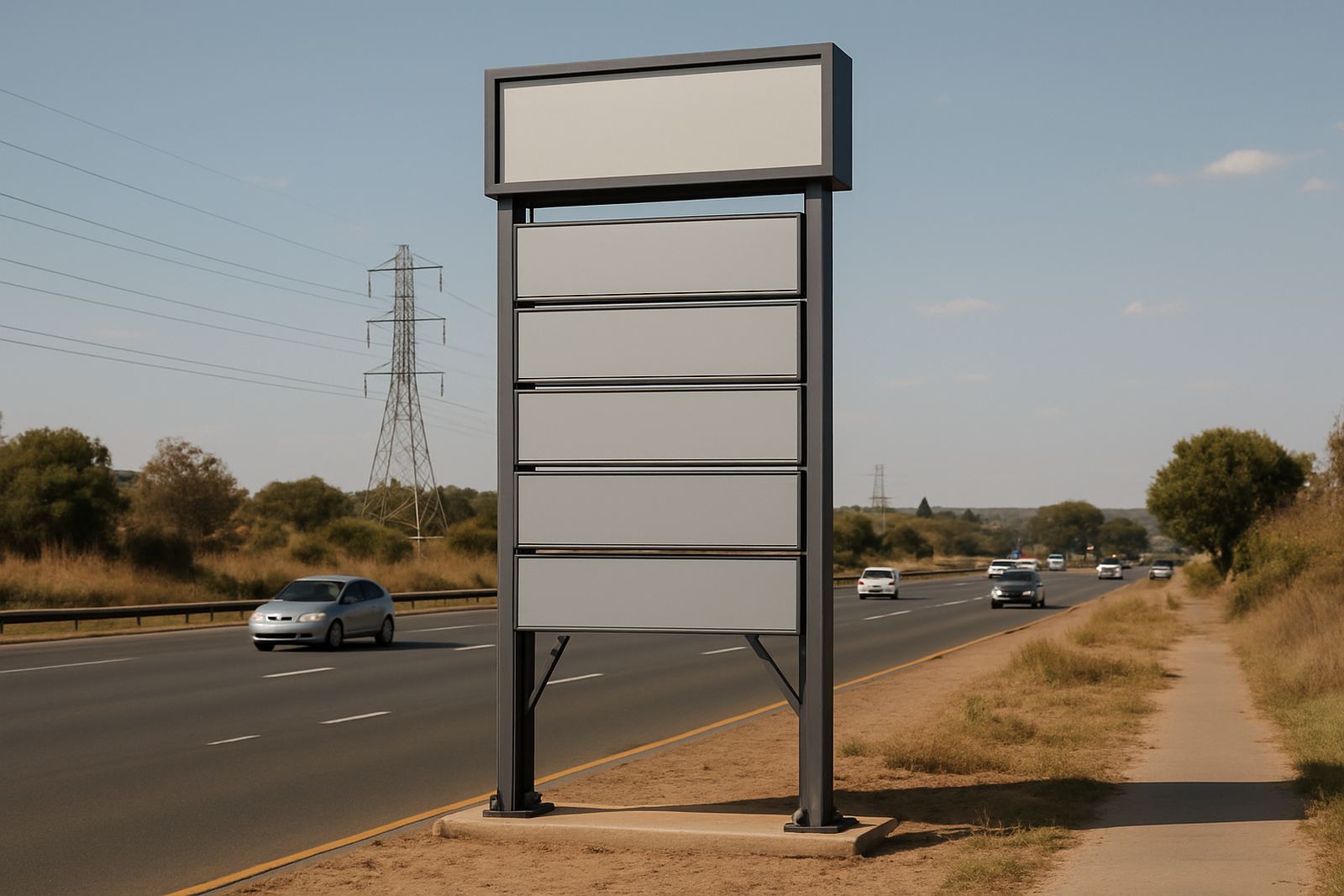
Tenant stacking is the order in which occupiers appear on the pylon and how much face area each one receives. It sounds simple, but it affects the full structure. A supermarket anchor may need a wider line, while smaller tenants fit into a tighter rhythm below. If the stack is not balanced, the pylon can look awkward and the structural load may end up heavier on one side.
Good planning also leaves room for future changes. We normally recommend reserving at least one adaptable position where a vacancy can be removed and replaced without disturbing the whole column. On larger sites in Sandton or Midrand, that can make a major difference when leases change. The pylon should not need a redesign every time a tenant moves out.
- Set the anchor tenant position first, then work down the stack
- Allow spare allowance for future tenant names and longer copy
- Keep tenant panels to repeatable sizes where possible
- Plan for vacancy panels that still look neat if a bay is empty
Illumination access should be built in, not added later
Many shared pylons are lit, which is sensible for visibility after dark and useful on sites affected by load-shedding. The issue is access. If a lamp, LED module or driver fails, maintenance teams must be able to reach the internal components safely. A sealed box with no proper access points will cost more over time, because every repair becomes a strip-down job.
For coastal or humid conditions, the hardware matters as much as the layout. Even in Johannesburg, dust and summer storms can get into poorly sealed sections. In places like Durban, moisture and salt air make access panels, seals and drainage even more important. A proper design should include safe entry, service space and weather protection around all electrical components.
- Use lockable access doors positioned for safe maintenance
- Keep drivers, transformers and wiring reachable without dismantling the full face
- Specify weather-resistant seals and coated fixings for exposed sites
- Check that lighting can be isolated for servicing without shutting down the site
Structure and footing must suit the full sign load
A pylon is not only a graphic object. It is a structural element carrying wind load, sign faces, internal lighting and sometimes multiple tenant cabinets. In Gauteng, gusts and seasonal storms can test a tall unit hard, especially on open stands near highways or exposed corners of new developments. The footing, base plate and steel frame need proper engineering from the start.
Where a pylon sits near a boundary wall, driveway or underground services, site coordination becomes critical. You cannot just decide later to move it 1,5 metres because a new tenant wants bigger lettering. That is why site surveys, structural coordination and approval support should happen before fabrication. On municipal sites, the set-back, visibility lines and height may also need checking against local rules.
For a mixed-use node in Modderfontein, for example, the owner may want a clear roadside pylon visible from both directions while keeping enough room for future retail tenants. If the base is undersized or the layout is too rigid, that pylon becomes a limitation instead of an asset.
Maintenance planning keeps the site looking professional
Shared pylons age in layers. One tenant updates their identity, another changes trading hours, and the illumination starts to dim unevenly. Without a maintenance plan, the structure quickly looks tired, even if the steel is sound. That matters on developer sites and municipal precincts where the pylon reflects how the whole place is managed.
Maintenance planning should be set up before handover, not after the first fault. We usually look at cleaning access, lamp replacement, repaint cycles, seal inspections and fastener checks. In dusty inland areas, face cleaning may be needed more often. In high-traffic areas like Randburg or Pretoria, accidental knocks from delivery vehicles should also be considered.
- Schedule regular inspections for corrosion, loose panels and failed lighting
- Keep spare tenant face templates on record for future changes
- Record wiring routes and service points for faster repairs
- Review the pylon after major tenant changes or site upgrades
A local example from a Gauteng retail node
At a retail centre in Gauteng, the owner wanted a clean roadside pylon for six tenants, with space to add two more later. The site was tight, the access road was busy and the leasing team expected changes within a year. Rather than overfill the first build, the stack was arranged with the anchor tenant at the top, smaller retailers grouped below and two reserve positions protected for future use.
The illumination was specified with easy service access, because the site is active well after dark and load-shedding had already shown how valuable reliable visibility can be. By planning the structure around tenant change and maintenance, the owner avoided a full rebuild when one occupier swapped its name plates. That is the practical value of a well thought-out multi-tenant pylon: it stays useful when the site changes.
What to ask before you sign off a pylon
Before approving a shared pylon, the owner, developer or managing agent should ask a few direct questions. If the answers are vague, the sign is probably being treated as a one-off fabrication instead of a managed asset.
- Can the pylon handle future tenant changes without structural alteration?
- How will the lighting be serviced safely and quickly?
- What is the plan for approvals, structural sign-off and installation timing?
- Is there enough reserve space for future tenants, vacancies or a name change?
- What maintenance record will be handed over after installation?
A well-planned pylon protects the property image and saves money over its life. For shared sites across Johannesburg, Pretoria, Centurion and Durban, that practical planning is worth more than a neat drawing on its own.